




Top-class finishing: Woodmaster tells you how
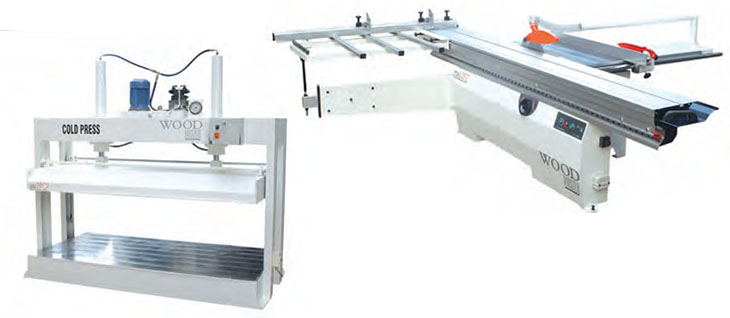
Hot/cold presses (L) are employed for laminating plywood and MDF with decorative sheets. Panel saws (R) are used to cut large boards with precision into smaller panels.
Modular kitchen-making machines have transformed the woodworking and interior industry by enabling accurate, fast and stylish production of kitchen solutions. From cutting and edging to drilling and assembling, these machines ensure precision and sustainability at every step.
As homebuyers demand better storage, durability and beauty, manufacturers equipped with advanced kitchen-making machinery will undoubtedly stay ahead in the competitive market.
Behind the elegance of a modular kitchen lies precise engineering and advanced manufacturing technology and processes. This is where Woodmaster India assists kitchen manufacturers – be they large factories or small workshops – meet the demand for quality and volume.
Modular kitchen manufacturing employs a combination of machines that automate the processing of kitchen cabinets, shutters, drawers and storage modules. These machines process raw panels, MDF, particleboard, plywood, HDHMR, laminated and acrylic boards, into ready-to-assemble kitchen modules.
The core purpose of these machines is to increase production efficiency, cutting and finishing accuracy; maintain consistency in design and dimension; reduce manpower dependence and production errors; and increase the overall profitability of the business.
Key machines
• Hot/cold presses come into play in the first stage of production, for laminating plywood and MDF with decorative sheets. They ensure firm bonding without bubbles, and uniform heat and pressure distribution.
• CNC panel cutting machines are used to cut large plywood, MDF or laminated boards with precision into smaller panels as per kitchen layout. They help in reducing material wastage by cutting with precision, minimising chipping on the laminated surface, and ensure smooth edges for further processing.
• Edge banding machines seal the exposed edges after cutting, to protect the board from moisture, enhance the durability and lifespan of the boards, and add aesthetic finishes.
• CNC routers/ nesting machines are used for designing cabinet shutters, drilling joints and carving profiles. They allow handle-less groove cutting, support complex designs and 3D profiling, and save time compared to manual carving.
• Multi-boring/ hinge boring machines carry out precision drilling to ensure proper fitting of hinges, channels and connectors. The accurate hole spacing increases assembly strength and reduces installation time.
• Membrane presses (optional) create membrane-finished shutters, an economical and stylish option. Apart from high-gloss and matte finishes, they offer the manufacturer wide customisation choices.
Together, these machines convert raw boards into perfectly engineered modular kitchen units ready for fitting on-site. Investing in modular kitchen machinery provides long-term business growth. Faster order completion and timely delivery lead to higher client satisfaction and increased business volumes. Their automation minimizes human error and dependence on highly skilled workers.
Accurate material cutting and nesting save raw material and increase profit margins. Perfect finishing increases brand reputation and resale value. They also offer better scalability – production can easily expand based on demand.
























- European symposium highlights formaldehyde emission limits
- Egger adopts holistic approach to waste management
- Taiwan’s Woodworking Machinery Industry Captivates Global Media on Opening Day of LIGNA 2025
- Coming of age of sustainability
- Intelligent packing line, sander from Woodtech
- Ornare introduces 5 new leather decors
- Richfill Edge Coat offers safer plywood finishing
- Jai’s Optimus range stays ahead of the curve
- Merino’s Acrolam sets new benchmarks in elegance
- Pytha 3D-CAD: where precision meets production
- Raucarp edge bands: simple, affordable
- Greenlam scores a 1st: High Quality Product Award
- Häfele turns space solutions provider
- Hettich bets on intelligent motion for evolving interiors
- Praveedh taking desi innovation to the global stage
- Turakhia shows off its Natural Veneers range
- Egger continues to ‘inspire, create, grow’
- Blum turns heads with new drawer, hinge systems
- Vecoplan tailors waste wood processing at Schaffer Holz
- Biesse starts training at HPWWI Mumbai
- HIFF 2025 underscores growing furniture capabilities
- Osaka Expo celebrates forests for humans
- CIFF Guangzhou 2026: connecting to create
- Feria Hábitat announces dates for 2026 show
- ‘Digital twins’ streamline factory planning, commissioning
- Smart illumination weds wood veneer
- Vecoplan ushers intelligent vibes
- New bio-based adhesives for particleboard
- Digital timber-tracking rolls across Poland
- Chitosan-rosin combo: flame-retardant adhesive
- Chicken coup: turning feathers into wood glue
- Start, Stabilise, Scale: A basic guide to modular kitchen manufacturing
- Fast Forward: surface tech attains maturity
- ‘Smart’ experiment unravels cooking behaviour
- Blum cabinet hinges earn BIS approval
- Ebco has smart storage solutions
- Hettich has holistic kitchen solutions
- Hexagon brings digital precision to manufacturing
- Leitz takes on modern materials, finishes
- Mirka’s smart tools for superior finishes
- Protego tabletop oils protect surfaces
- Top-class finishing: Woodmaster tells you how
- Keen to cut it right for India: Freud’s Andrea Komadina
- ‘Rainbow tools’: functionality or hype?
- Pidilite’s practical skilling initiative for modern joinery
- PVA adhesives: weather-ing challenges in India
- How loyalty plays in Tier-2/3 ply, laminate markets
- AHEC’s ‘Days of Design’
- IndiaWood 2026 to showcase Indian capabilities